I have three wildly different readers in my house.
My oldest is an avid reader. She always has been. She gets lost in books, and her bedroom holds more books than clothes. According to an unofficial standard I once read and have chosen never to question, you only need 1,000 books to call a room a library. She is getting close.
My middle child likes to read what he likes to read, but he is a harder sell. He doesn’t enjoy just anything, and he doesn’t often disappear into a book. We work hard to find authors and series that will capture his interest. We have found success, but he does not walk into a bookstore and simply smile.
And my youngest, quite frankly, is struggling to learn to read. Her comprehension is excellent when someone reads to her, but learning to decode the words herself has been hard. That makes the practice she so desperately needs even harder to sustain.
They are wildly different readers. I often wonder how and why three children growing up in the same house can be so different. But they are, and despite those differences, I never stop in my pursuit of raising readers. There are research-backed reasons for that pursuit.
Being able to read is very different from being a reader.
A child can read every word on a page and still struggle to understand what the text means. Another child can demonstrate reading proficiency at school and rarely choose to open a book independently. Both children have learned important reading skills. Neither has necessarily become a reader, and becoming a reader is the ultimate goal.
Following the release of the PISA 2025 results, reading outcomes are in the news again. PISA measures what 15-year-olds around the world know and can do. More than 760,000 students from 91 countries and economies participated in the most recent assessment. The results are not ideal. Across OECD countries, reading scores fell 14 points between 2022 and 2025. That is the largest decline between two PISA assessments ever recorded.
As parents of elementary-aged children, you may wonder how much we should worry about the reading performance of today’s 15-year-olds. For some of you, 15 is nearly a decade away. The answer, though, is simple: We should care deeply.
If we want different outcomes at 15, we must begin long before 15. The skills, knowledge, and identity of a reader are built across childhood. So, where do we start?
It is abundantly clear from the research that schools must provide explicit and systematic foundational reading instruction. When children can recognize words accurately, read with increasing fluency, and understand the language before them, books become places they can enter independently.
Opening the door, though, is not enough.
Reading growth is cumulative. Every book contributes words, ideas, and experiences that make the next book more accessible. Reading generates more reading. As children’s skills and knowledge grow, reading becomes easier. They are more likely to pick up a book at the end of the day when it does not feel quite so hard.
The opposite can also happen. Difficulty leads to avoidance. Avoidance limits practice. Limited practice allows gaps to widen. This is why children who find reading difficult cannot simply be told to “read more.” They need trusted adults who provide meaningful choices, support them through challenging texts, and help them experience success before avoidance becomes part of their identity.
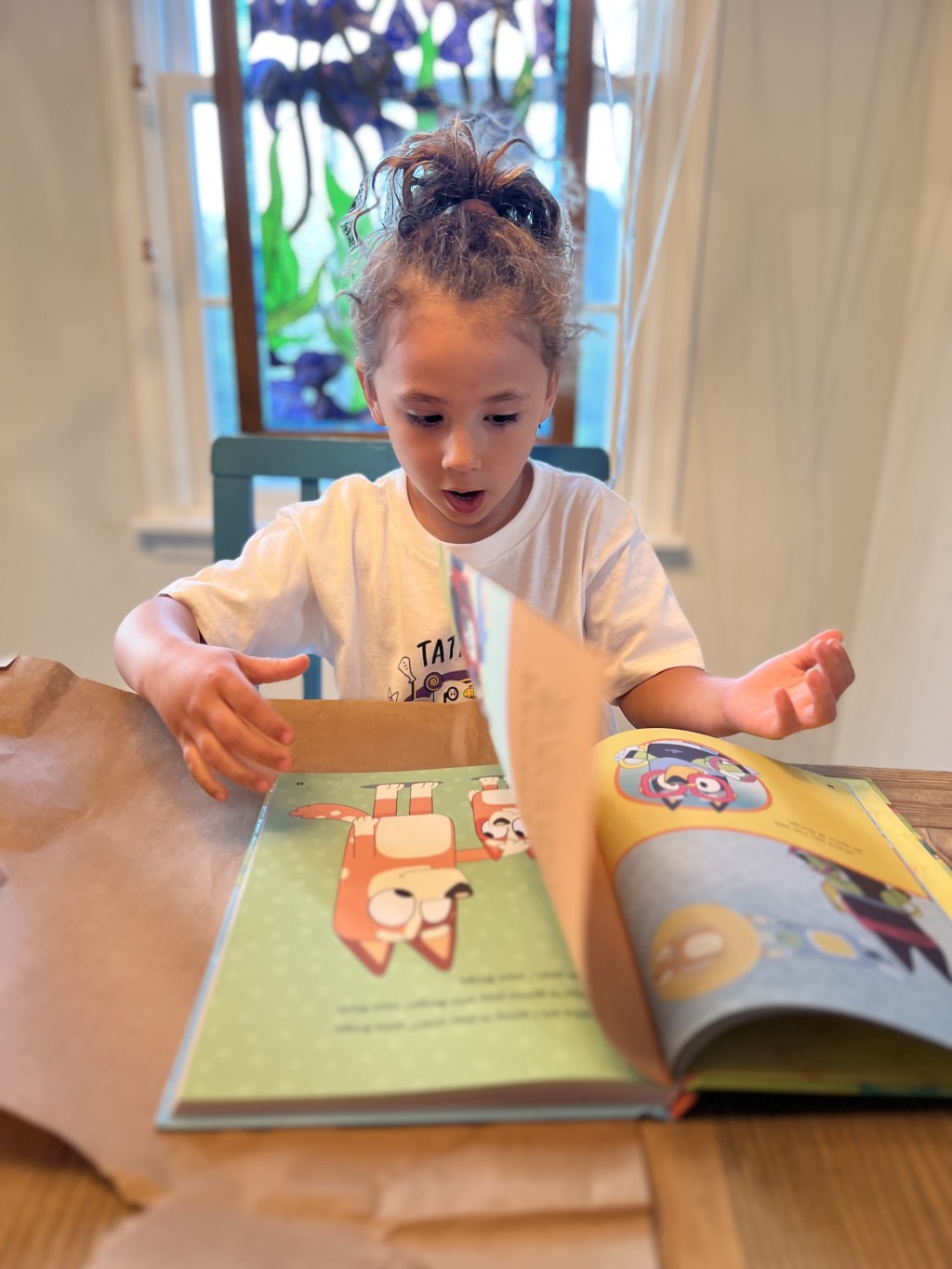
At home, choice matters. Offer graphic novels, series, nonfiction, mysteries, joke books, biographies, and old favorites. Let children reread books they love… and abandon the ones they simply cannot get into. Keep reading aloud, even after your children can read independently. Let your children see you reading for pleasure. Share the laughter, suspense, and surprise in the books you read together. Pair books with experiences. Visit bookstores and libraries.
Your job is not to recreate school at home. Children become readers when books are associated not only with accuracy and accountability, but also with discovery, comfort, laughter, wonder, and belonging. One of the most important contributions a family can make is helping children experience reading as a natural and enjoyable part of family life.
Tonight, reading will look different for each of my three children. One may disappear into a novel. One may need help finding a book that feels worthy of his time. One may read a few slow, hard-earned lines before handing the book to me so I can finish the chapter.
And I will sit down beside her.
Because raising readers is not only about teaching children to read the words on a page. It is about helping them discover that books hold places they can go, people they can become, and ideas that can change the way they see the world.



 Home
Home 
Leave a comment