I have been carrying around two comments lately, both as a parent and as an educator.
The first came from my oldest daughter, who recently said, “Mom, I don’t want more work. I want harder content.”
Well, okay then. Apparently, I am raising a tiny curriculum consultant.
The second came from a colleague who asked, “When did the idea start that physical and social development are so much less important than academic development?”
On the surface, these sound like two totally different conversations. One is about a child wanting to be challenged, to think deeply, to create, and to wrestle with ideas that are just out of reach. The other is about developing the whole human, not just the “smart” one. But at the heart of both comments is the same complicated word: rigor.
And let me tell you, as an educator, rigor is a hot topic. I answer questions about it all the time. I plan programming around it. I read research about how children learn, think, struggle, and grow so that we are building toward the right kind of challenge. But here is the tricky part: rigor is often more perception than definition. And when I tell you no one is working from exactly the same definition, I mean no one.
So, let’s dive in.
In education research, academic rigor is often described in one of two ways: workload or cognitive challenge. Workload is the amount of work students are asked to complete. Cognitive challenge is the level of thinking students are expected to engage in. These two ideas often get blended together, even though they are not the same thing.
Students, understandably, often experience rigor as “a lot.” A fast-paced class, a heavy workload, a lot of reading or writing, unclear relevance, and sometimes a teacher who feels more demanding than supportive. In those moments, rigorous can start to feel like a polite academic word for “overwhelming.”
Gifted and advanced learners give us another helpful lens. For many of these students, “more” is not always better. More of what they already know can feel like punishment for being ready. What they often need is depth, complexity, abstraction, acceleration, and opportunities to apply ideas in more advanced ways. In other words, they do not just need more pages. They need better problems.
This brings me back to my daughter’s very clear statement: “I don’t want more work. I want harder content.”
That is the distinction.
Rigor is not five worksheets when one meaningful problem would do. Rigor is not reading ten books while sitting alone; it is learning how to discuss one book with a partner. Rigor is not memorizing, copying, and regurgitating information just because the pile is large. Rigor is thinking, connecting, questioning, applying, explaining, defending, revising, and creating.
And the research supports this distinction.
One study that compared workload and cognitive challenge found that cognitive challenge was more strongly connected to students’ growth in critical thinking and self-motivated learning. That matters because our goal is not simply to produce children who complete work while someone is standing over them. Our goal is to help raise learners who want to think, who know how to think, and who can keep thinking when the adult leaves the room. Interestingly, the only workload measure that showed a positive association was reading. So yes, please keep reading with your children. That one stays.
So what does this mean for us as parents?
It means we do not have to be automatically impressed by hours and hours of homework. I know that sounds almost rebellious, but there it is. More time spent does not always mean more learning gained. Sometimes it means the assignment was inefficient. Sometimes it means the child was exhausted. Sometimes it means the work was too easy, too unclear, or too disconnected from anything meaningful.
Instead, we can ask better questions.
How did you learn that?
What did you have to figure out?
Did anything connect to something you learned in another class?
Did you change your mind while you were working?
Were you proud of what you created?
We can also watch for signs of real engagement. Are they talking about what they learned at dinner? Are they eager to return to a project? Are they asking new questions? Are they reading because they are curious, not just because a timer is running? Are they making connections in the car, in the kitchen, or while you are trying to unload the dishwasher in peace?
That is often where real rigor shows up.
And to my colleague’s question about when academics began to take precedence over physical and social development, I think part of the answer is this: it happened when we confused academic rigor with academic volume.
If a child can read fluently but struggles to share space, collaborate, listen, take turns, or manage frustration, then “workload rigor” might look like giving that child a basket of books and asking them to read alone. They may fly through the books. They may look very advanced. They may even be very happy not to negotiate with another human.
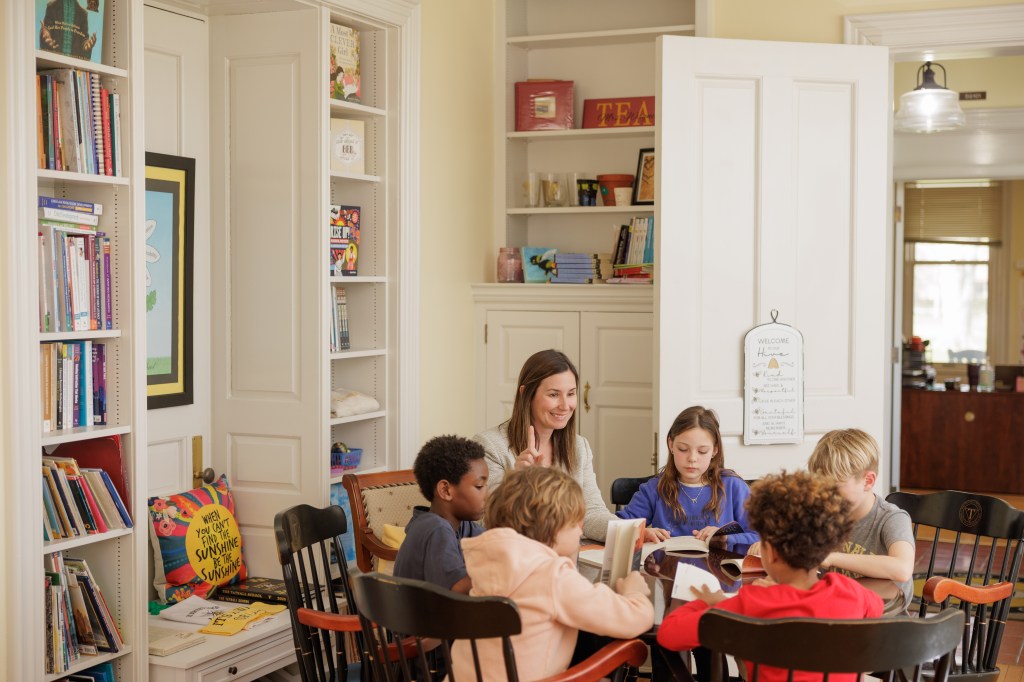
But cognitive rigor might look like sharing that same basket with a partner. It might mean reading fewer books, but doing the harder work of deciding who turns the page, how to solve a disagreement, how to listen to someone else’s idea, or how to explain your own thinking without grabbing the book and declaring yourself the mayor of reading.
That work is academic. It is also social. It is also emotional. And for a child who struggles with sharing, it is deeply rigorous.
We are not raising children to be excellent worksheet completers. We are raising readers, thinkers, friends, teammates, problem-solvers, question-askers, and future adults who can enter a room, understand the task, understand the people, and figure out how to move the work forward.
So yes, I want our children challenged. I want them stretched. I want them to feel the productive struggle that comes from thinking deeply and doing meaningful work.
But I do not want us to confuse rigor with exhaustion.
I do not want us to mistake a heavy backpack for a heavy cognitive lift.
And I definitely do not want my daughter to come home with 30 more problems when what she really asked for was one bigger problem to wrestle with.
Because honestly, she was right. More work is not always harder.
Harder is defending an idea, revising a plan, making a connection, solving a problem without an obvious first step, or sitting with the discomfort of not knowing the answer right away.
That is the kind of rigor I want for our children.
The kind that builds thinkers, not just finishers.
The kind that helps them take on big ideas and big problems with confidence.
And that is the kind of hard our children deserve.





 Home
Home 
Leave a comment