I am going to step away from my more traditional posts this week, the ones that lean on quantitative research to answer the questions many of us are quietly carrying around. Instead, I’m bringing you a bit of homegrown research and a whole lot of lived experience.
My family is full of people with high-functioning anxiety. Some of us are high-functioning because of medication, some because of therapy, some because we’ve become downright talented at coping strategies, and some because we use all three. So, while it was still tender to name out loud, it wasn’t exactly a shock when our first grader began showing clearer signs of anxiety.
For her, it looked like begging us to stay in bed with her until she fell asleep, and then needing us again, again, and again throughout the night. It looked like pure joy and excitement to try something new, followed by refusing to get out of the car once we arrived. It looked like going to a best friend’s birthday party and sitting on my lap because there were people there she didn’t know. And it looked like a ton of work refusal at school, not because she couldn’t do it, but because she was terrified of getting it wrong.
We started talking with her about what she was feeling. She’d say things like, “I’m not worried to go to bed at night… I just love you soooo much.” Which is both adorable and, if you’re a parent, also a sentence that makes your stomach drop a little because you know it’s not the whole story.
Eventually, we got her into the doctor’s office. We talked and talked about what we were seeing. In the end, it came as no surprise to us. She was diagnosed with anxiety, and the recommended treatment plan included therapy and medication.
We kept talking about it at home. She asked a lot of thoughtful questions, including why she would need to take medicine on the weekends when, in her words, school was the only place she felt nervous. (Onion peel layer number one: at the doctor’s office, she nervously giggled and shared that she never felt nervous.) I gave her my best answer. She looked unconvinced.
And then something happened that I wish I could bottle and hand to every parent who has ever lain awake wondering if they’re making the right call.
Later that day, I overheard one of my older children talking to her. He said, “I heard you’re starting medicine tonight for your anxiety. Did you know I take medicine for my anxiety?”
She asked him the exact same question she had asked me: “Do you also have to take it on the weekend?”
He said, “Yes. It really helps me crash out less. When I don’t take it, I worry about things that are small problems. Like, I would worry nonstop about whether a friend could come over to play. I couldn’t stop worrying about it. I couldn’t sleep. I would ask Mom and Dad a hundred times. But now, I can realize that it’s a small problem, and the playdate will most likely happen even if Mom and Dad can’t give me an answer immediately.”
Then he asked, “Do you have a weekend worry?”
She said, “I guess so. I worry about meeting new people.”
He paused and said, “Hmm. That must be hard, because I know you want to try field hockey.”
Silence. Then she asked him, “Do you have school worries too?”
He admitted that he did. And then he asked her if she did, too.
Her words came tumbling out, like she had been carrying them around in her little body and was relieved someone finally knew how to ask.
She told him that when she comes to a word she doesn’t know, she worries that she should know it. Then she worries her teacher can’t help her. Then she worries she won’t finish. And while she’s worrying, time passes, and she runs out of time, and nothing gets done. Then she worries that she let her teacher down. Or Mommy down. And then she just cries.
My son simply said, “I get that.”
There was a small stretch of silence. The kind that feels like something heavy being set down.
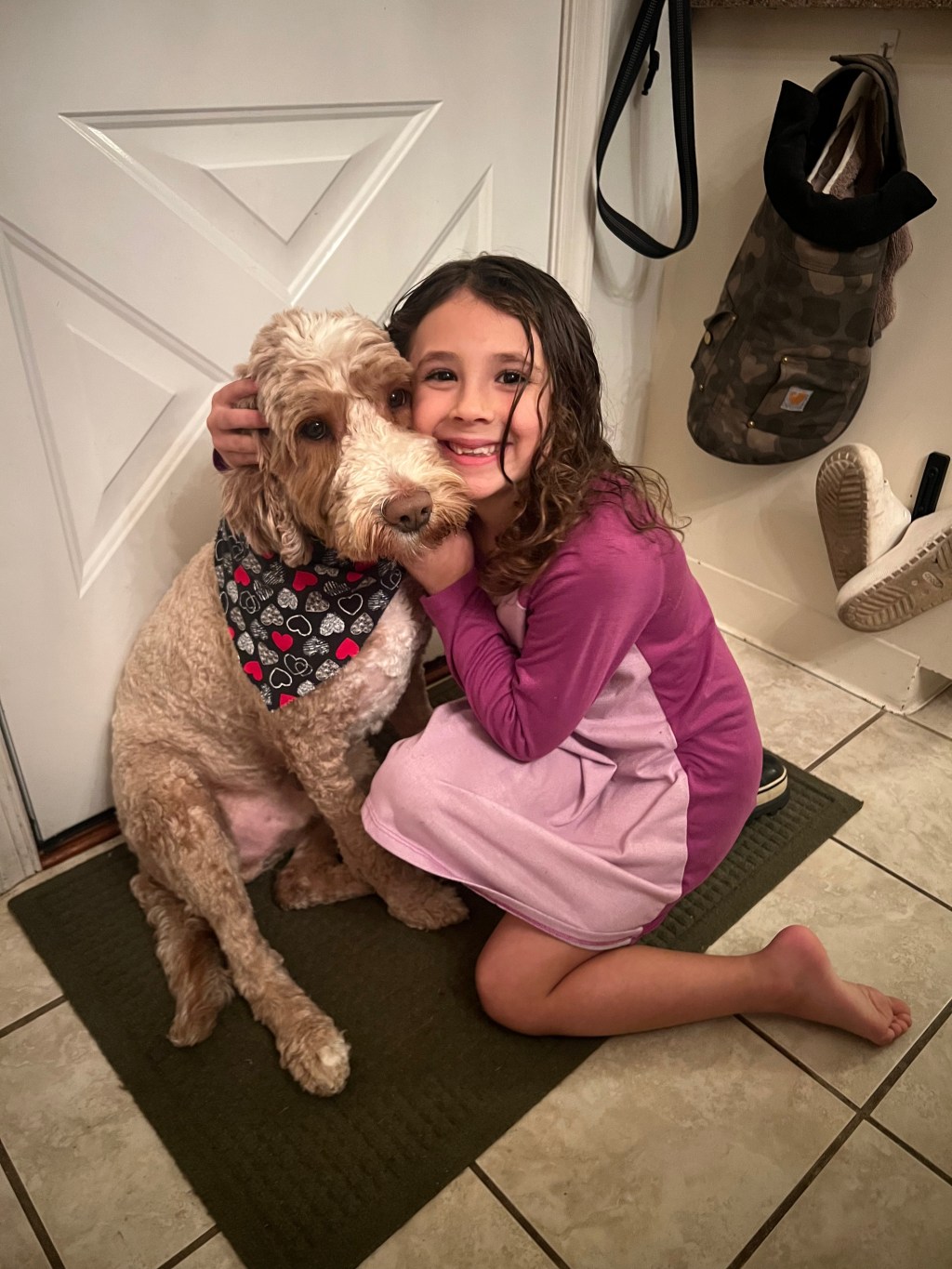
Then he said, “You know, in addition to medicine, I went to a doctor to get strategies. And my favorite was to snuggle Wheeler (our dog) when I got really worried about something. Do you want to borrow that strategy?”
She must have said yes, because a little while later, she and my son put on a movie together and snuggled with our dog. That night, they both took their pills and went to bed.
I’m sharing this because so many of us are making hard decisions in a world that feels fundamentally different from the one we grew up in.
What is typical? What is just outside of typical? What is beyond? Do we medicate? Do we wait and see? How do you even get into a therapist when the wait is so long? Can we wait the wait? How long is too long to wait? Is the child struggling academically? Struggling socially? Struggling athletically? All of it?
As an educator, I can always offer a perspective grounded in research. As a mom, I can offer a perspective grounded in the messy reality of loving a child and trying to make the best choice with the information you have.
But today, I wanted to offer the perspective of a first grader and a middle schooler.
A small, quiet, overheard conversation between a big brother and his little sister, where neither one tried to fix the other. They simply understood each other. And they made space for the truth.
I don’t know that we always need the answers as adults. Sometimes what our kids need most is the chance to name what’s happening inside them, and to feel less alone in it. This isn’t an entry meant to convince anyone to make any specific decision. It’s simply a glimpse into my world. A gentle nudge to let your children weigh in, to dig into their feelings with you, and to remember that connection is a strategy, too.
And maybe, if you’re standing in the same place I’m standing, trying to be brave and wise and calm while your heart is doing cartwheels, it’s also just this:
You’re not the only one.
I’m walking this journey with you.





 Home
Home 
Leave a comment