So our Kids Can Read… Now What?
A follow-up to last week’s blog on fluency and the Simple View of Reading.
Last week, I dove into the research on when children typically become fluent readers (spoiler alert: it’s a marathon, not a sprint) and explained a bit about the Simple View of Reading. But what about when your child is reading fluently? What if they’ve checked the “decoding fluently” box and are now flying through chapter books?
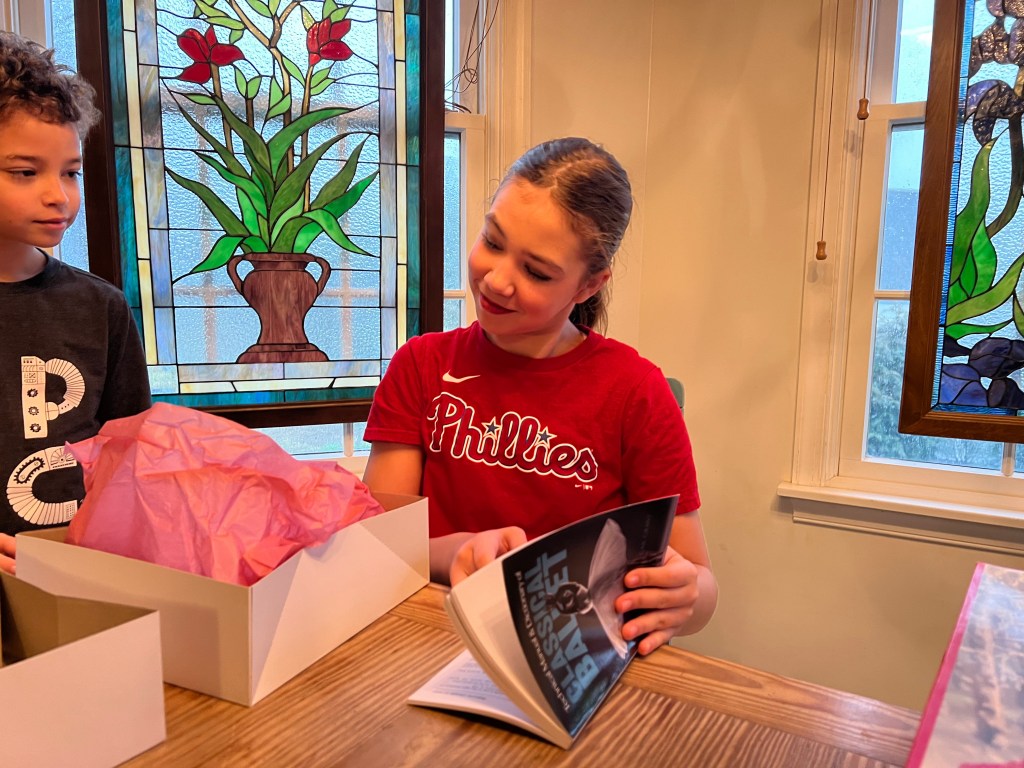
I’ve got one of each at home: one child who is capable of reading but… mysteriously “not in the mood” (fifth-grade energy is real), and another who consumes books like snacks and then insists we discuss every chapter, character motivation and obscure metaphor over dinner. So what’s a parent to do?
Let’s take a moment to revisit the Simple View of Reading and introduce a new model to the mix: the Cognitive Model of Reading.
Reading Is All About Meaning (Even If It’s Pokémon)
At its core, reading is about making meaning. Writers write to share an idea—and readers read to get that idea. The Simple View of Reading says that true reading comprehension is the product of word recognition (i.e., decoding and fluency) multiplied by language comprehension.
Last week, we tackled word recognition; now it’s time to look at the other half of the equation.
According to the Cognitive Model of Reading, language comprehension includes:
- Vocabulary knowledge
- Background knowledge
- Understanding of sentence and text structures
- Strategic reading skills (How do I read a comic book vs. a nonfiction article?)
So, How Do We Keep the Reading Momentum Going?
Research tells us that comprehension improves over time as kids develop stronger working memory, learn more about the world, and read more and more. Luckily for us, a lot of this work is done in school, but a lot of this can also happen outside the classroom. Here’s how:
1. Build Vocabulary + Background Knowledge (aka, “Talk About Stuff!”)
Want to boost your child’s comprehension? Give them more words and more world. Seriously. Vocabulary and background knowledge go hand-in-hand: if they understand the topic, they’ll understand the words. And if they understand the words, they’ll dive deeper into the topic. It’s the world’s best feedback loop.
Here’s what this looks like in our house: we go for a walk at Hagley and stop to chat with the blacksmith or watch the mill race churn. Then we keep talking about it all week. “Remember how they made paper back then? Want to try? Let’s pull up a how-to online.” or “Hey, doesn’t that look like the water wheel we saw?” Then we “casually” check out an I Survived book or a nonfiction read about that time period. The key? Be sneaky and make it fun.
2. Teach the How of Reading Different Texts
Your kids probably know how to read a sentence—but do they know how to read a comic panel? Or a science article? We teach this at school, but you can reinforce it at home.
If they’re reading a graphic novel, point out how to follow the panels and interpret the images. Reading nonfiction? Be dramatic! Say things like, “Wait! That’s fascinating. I’m underlining this so I can come back to it later.” Reading fiction? Talk about story structure: characters, setting, problem, and solution. Encourage predictions. Ask about the main idea. Pretend to be baffled by a twist—drama helps!
3. Keep the Books Coming (Yes, Even Dogman)
Want your child to become a better reader? Have them read… a lot. Libraries are magic. Book swaps are gold. That neighbor with a garage full of Magic Tree House? Your new best friend.
Don’t stress if they’re obsessed with Dogman. Let them read all the Dogman, and then gently nudge them toward something new when they’re ready. Ask teachers for suggestions. Subscribe to a kid-friendly magazine. Turn on captions while they’re watching shows. Whatever keeps those eyes on the text and those brains in gear.
And talk to them. Talk about what they’re reading. Ask big, open-ended questions like, “What surprised you?” “What would you have done?” or, my personal favorite, “Would you survive in that story?” (Answer: My children are always confident they would survive. I would probably not.)
Let’s not overcomplicate it: help your kids build knowledge, talk about what they’re reading, and give them access to books they love.
And if that means you accidentally become an expert in Pokémon evolutions or the plot lines of Amulet? Well, welcome to the club. There’s no badge, just a well-worn library card and a growing pile of books on your coffee table.
Next up? Well, I’ll be tackling how I support my older two kids when reading gets hard again, whether it’s middle school texts or tricky content.
Until then, I’ll be over here pretending I totally understand what a Charizard EX actually does.



 Home
Home 
Leave a comment