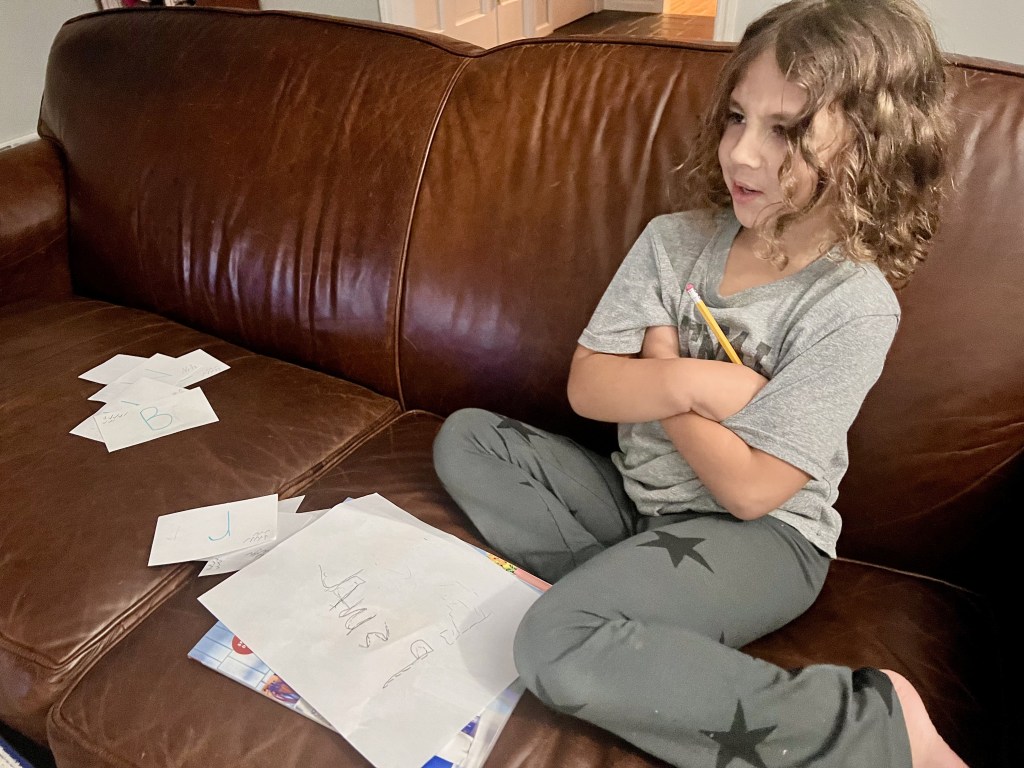
Over Thanksgiving weekend, we headed up north to visit my parents. My dad has a favorite saying, one that he reminds us of regularly: “Math rules the world.” When I was younger and found myself in trouble (hard to believe, I know), my punishment wasn’t the usual time-out or grounding, it was pages and pages of math problems. While I don’t exactly take that approach with my own kids, we do try to weave mathematical thinking into everyday life whenever the opportunity arises.
This approach has given us three very different “mathematical humans” in our household. My oldest thrives on the challenge of math and works relentlessly to find the right answer. My middle child, on the other hand, says with perfect candor, “Just because I’m good at math doesn’t mean I like it.” And my youngest? She loves showing off what she knows but prefers to skip the heavy lifting that comes with deep, critical thinking.
This leaves me, like many parents, asking the big questions: How do I help them feel confident in math? How do I encourage them to take risks in math? And most of all, how can I get them to enjoy math?
Jo Boaler’s chapter Creating Mathematical Mindsets: The Importance of Flexibility with Numbers from the book Mathematical Mindsets offers some fantastic insights into these questions. Boaler starts with a bold claim: young children love math. But somewhere along the way, their love gets replaced with a belief that math is all about rigid rules and instructions. To combat this, she suggests that the best thing we can do is encourage kids to play with numbers and shapes, search for patterns, and explore connections. She explains that successful mathematicians think flexibly, approach math with curiosity, and have the confidence to figure things out.
Here are three key takeaways from Boaler’s chapter:
Number Sense
Number sense is the ability to understand numbers, their relationships, and how to use them flexibly. High-achieving math students tend to solve problems this way. For example, instead of subtracting 6 from 21 by counting backward, they might reframe the problem as 20 – 5. In contrast, students who struggle with math often rely rigidly on procedures, even when simpler methods are available.
How can we encourage number sense at home? After your child solves a problem one way, challenge them to solve it another way. Or have them share their strategies with a sibling or friend, it’s a great way to highlight different approaches and foster flexible thinking.
Math Facts
Boaler doesn’t mince words here: “Math facts by themselves are a small part of mathematics.” She explains that facts are best learned through engaging, hands-on activities, not rote memorization. Unfortunately, drills and flashcards often send the message that knowing facts equals success in math.
So, what’s the alternative? Turn math into a game. Try activities that encourage deeper thinking, like matching flashcards that show the same quantity in different ways (e.g., 9 × 4, 4 × 9, a 4×9 array, or 36 dots split into groups). This not only helps children make connections but also keeps math interesting and fun.
Compression
This concept was a lightbulb moment for me! Boaler explains that math is incredibly “compressible.” When kids first learn a new concept, it feels like it takes up a ton of mental space because it requires sustained effort and thinking. But once they truly understand it, seeing the connections and the bigger picture, their brains can “compress” the concept into a neat little file that’s easy to retrieve.
Here’s the kicker: compression only happens when kids engage in conceptual thinking. Rules and rote methods? They don’t compress. This means it’s critical to focus on helping children understand the why behind math concepts, not just the how.
Finally…
So, yes, math rules the world, and maybe my dad was onto something with all those math problems (though I’d never admit it to him). While I’m not advocating for punishment by fractions, we can all help our kids see math as a tool for exploration, creativity, and even fun. And who knows? With a little number sense, some creative math games, and the magic of compression, maybe one day my middle child will say, “I don’t just tolerate math; I kind of like it.” Or at the very least, my youngest might stop rolling her eyes at it long enough to explain her thinking.




 Home
Home 
Leave a comment